A Remote Setpoint Is Not an Authorized Operating State
A contractor maintained cold rooms at three sites used by France's blood service. After their settings changed overnight, an on-call technician saw temperatures rising. What should determine whether a remote setting may take effect while a room holds plasma?
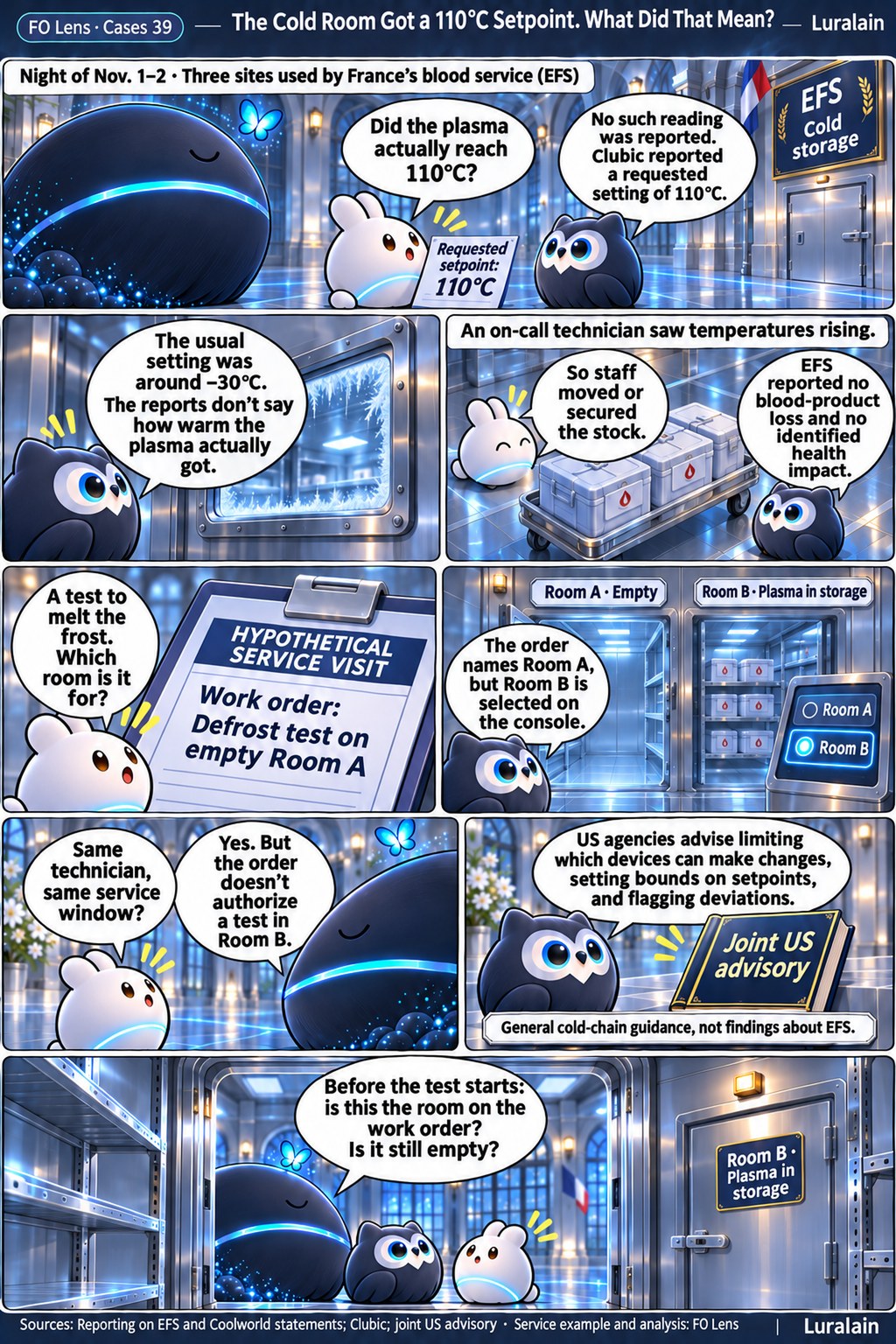
On the night of 1–2 November 2026, temperature and defrost settings changed at three sites used by the Établissement français du sang (EFS), France’s blood service. Clubic reported a requested temperature of 110 °C on equipment normally set near −30 °C. EFS reported that staff protected the blood products. A service connection gives a contractor a way to adjust the equipment. Before the controller applies a particular setting, what establishes that the change is authorized for a room that currently holds plasma? This piece separates three things that question contains: who can reach the equipment, what setting it received, and what conditions the loaded room may operate under now.
The supplier’s equipment and the blood service’s account
In its 3 November statement, EFS identified a cybersecurity incident affecting a refrigeration supplier. Cold-room monitoring and control installations were affected. The stock included plasma intended for transfusion and plasma destined for the manufacture of medicines. EFS credited its monitoring and alarms with detecting the anomalies quickly. Staff transferred or secured the products. EFS reported no blood-product loss and no identified health impact.
French reporting identified the supplier as Coolworld. In its own statement, Coolworld acknowledged an incident involving remote monitoring software on a limited number of refrigeration units. It attributed the reported vulnerability to a third-party component and declined to discuss individual customers. The public accounts leave the precise route by which each controller received a change unresolved.
Why a change through the service channel looks like maintenance
A contractor can use a remote console to diagnose a fault and adjust a unit while staff remain on site. From the site’s perspective, an incoming change can therefore look just like routine service, and most of the time it is. Even when the technician and the work order are known, one detail still matters before the setting takes effect. Which room did the technician select?
Three questions at the cold-room controller
Who can reach the equipment? The service connection gives the contractor access to the equipment it maintains. Identifying the person or system behind a particular command requires evidence about that command.
What setting did the equipment receive? Clubic identified 110 °C as the requested value. A setpoint gives the controller a target. The accounts give no peak temperature for the plasma and no time spent at any particular temperature.
What conditions may this room operate under now? At the time of the incident, these rooms held material that had to remain frozen. A maintenance setting can have a legitimate use on an empty unit. Applying it to a loaded unit calls for a decision about the selected room, its contents and the work currently authorized there.
Consider an ordinary service visit. A technician is authorized to test a defrost cycle on an empty unit and selects the adjacent, loaded unit on the remote console. The technician and the maintenance window are the same in both cases. The unit selected changes whether the test may begin. This hypothetical error raises the same operating question without requiring an attacker.
What the US advisory asks operators to limit
On 5 November, CISA, the FBI, HHS, USDA and the US Department of Transportation issued guidance for industrial refrigeration and cold-chain monitoring systems. The agencies recommend restricting which devices can make changes. They also recommend setting limits on the setpoints of equipment downstream of controllers and alerting on deviations. The advisory names no EFS site and offers no findings about the French incident.
A limit can exclude a value outside the equipment’s safe range. A value inside that range can still be unsuitable for a particular use. A defrost test illustrates the difference. What matters at the moment the setting would take effect is whether this unit can undergo that test with its present load.
What the night shift could establish
Clubic reported that an on-call technician saw the temperature rise. Staff regained control of some equipment or took it out of service and moved contents as needed. That account explains how staff responded to a physical change. It leaves open what limits were configured when the settings changed.
In the same coverage, security specialist Benoît Grunemwald recommended independent temperature supervision. For an operator, that raises a practical question after any remote adjustment. If the maintenance display becomes unreliable, what reading can staff use to decide whether to keep the stock in place? The public accounts do not describe how EFS wired its sensors or alarms.
What this case does not show
It does not show how the changes reached each controller. Coolworld attributes the vulnerability to a third-party component; the route, the number of units and the duration are not public.
It does not show that the plasma was exposed to 110 °C. That is the reported requested value. The temperatures actually reached are not in the accounts cited here, and EFS reports no product loss.
It does not show which setpoint limits or alarms were configured, or that any particular control would have stopped the change. This piece does not infer missing controls from the outcome.
It does not show a link to the October incidents in French supermarkets, which reporting so far has not established.
It does not treat the US advisory as a finding about this incident. The advisory is general guidance.
Where the check belongs
A service agreement may cover a whole bank of cold rooms, and each controller may accept the same range of values. A work order for a defrost test on an empty unit has a narrower scope. Before the test begins, someone or something must establish that the selected unit is the one covered by the order and that it is still empty. Securing the channel narrows who can send a change, and a range on the device narrows what values it will accept. Neither, on its own, establishes that.
The proposition
Access through a service channel is a fact about the connection. A setpoint is a fact about what the device was told to do. Whether a loaded room may operate under that setting is a fact about the room, its contents and the work authorized there now.
A remote setpoint tells the controller what to do. Whether it may take effect depends on the work authorized for this room and what the room holds now.
Source note. EFS’s account is drawn from its 3 November statement as reported by BleepingComputer and French health press. The supplier’s account comes from Coolworld’s statement as reported by BleepingComputer. The reported settings, the technician’s observation and the discussion of independent monitoring come from Clubic. The sector recommendations come from the joint advisory US Government Partners Urge Hardening Industrial Refrigeration and Cold Chain Monitoring Systems (CISA, FBI, HHS, USDA, DOT, 5 November 2026). FO Lens has not independently examined the equipment or its logs. The maintenance example and the execution-boundary reading are FO Lens’s.
Related
- A Suspended Warning Is Not Automatically a Safe State — Cases 37: how an operator determines a safe state for each function.
- An Updated Version Is Not a Patched Runtime — Cases 38: the gap between a recorded change and the state observed in operation.
The essay as a webtoon
The same characters also star in a daily-life webtoon, Rurun Clocks In.