A Denied Name Is Not a Denied Action
An open-source server lets AI assistants call AWS APIs, and operators can list operations it must refuse or confirm first. For operations whose names contain consecutive capital letters, the server converted the name differently from the way operators were told to write it, so the entry could fail to match and the operation could proceed. What does a deny rule establish about the action that actually reaches it?
AWS’s open-source AWS API MCP Server lets an AI assistant call AWS APIs on a user’s behalf. Operators who run it locally can add a policy file that lists operations the server must refuse, or must ask the user to confirm first. On 10 November 2026, AWS published CVE-2026-125271: for operation names containing consecutive capital letters, the server converted the name into a different form from the one operators were told to write, so a correctly written entry could fail to match and the operation could proceed. This piece reads the distinction that case makes visible. A rule that names an action is a fact about the policy. Whether the rule recognizes the action that actually arrives is a fact about the comparison made at the moment of execution.
A correct entry that matched nothing
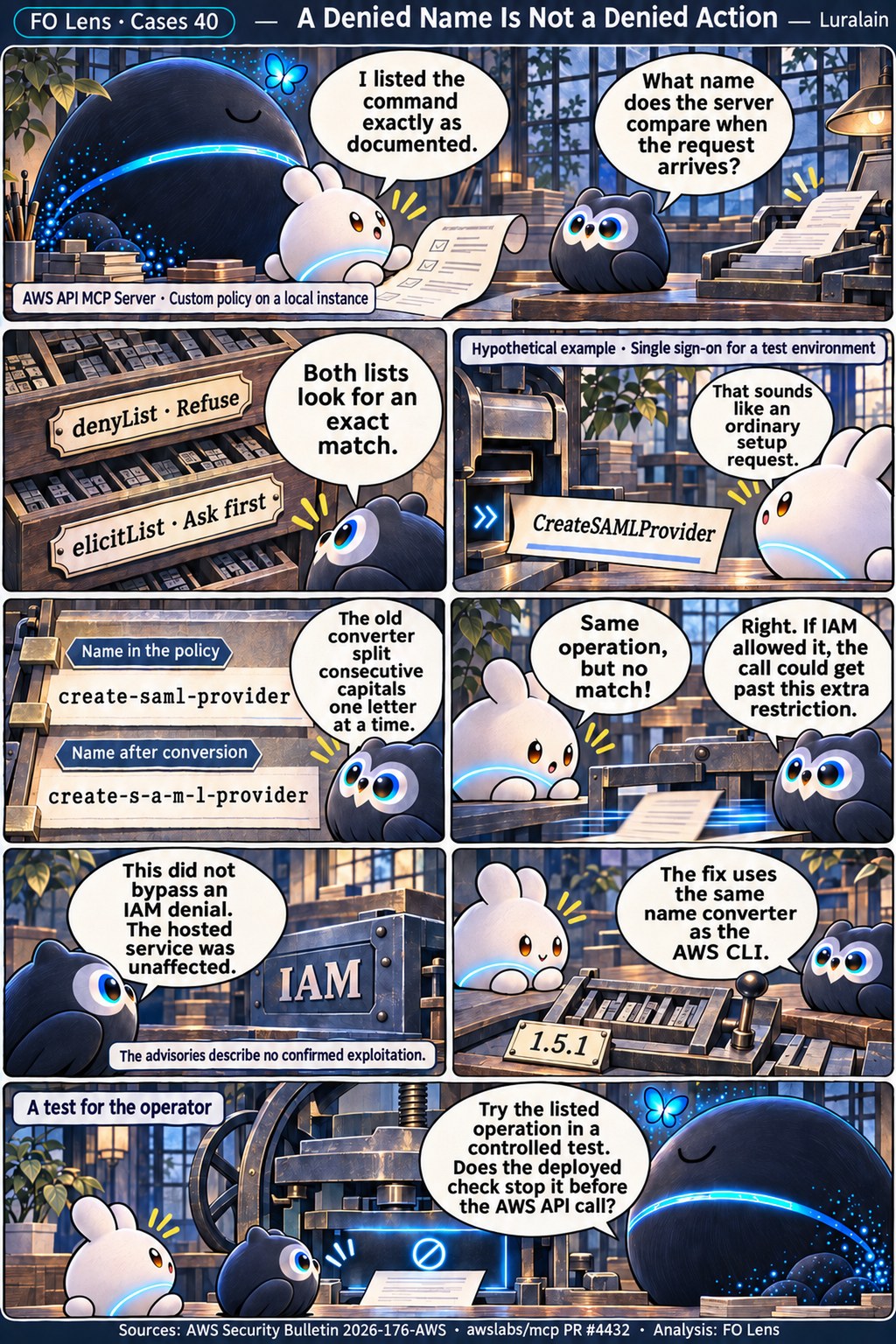
The server’s policy file holds two lists. A denyList names commands the server will refuse. An elicitList names commands that need the user’s confirmation before they run. Entries are written the way the AWS command line spells them, for example aws iam create-saml-provider, and are matched as exact strings.
When the assistant asks for an operation, the server converts the API’s internal name into that command-line form and compares it with the lists. The description of the fix in pull request #4432 explains how the conversion went wrong. The old method split runs of capital letters one letter at a time. CreateSAMLProvider therefore became create-s-a-m-l-provider, not create-saml-provider. The pull request description puts the number of affected operations at about 642. An operator who wrote the documented form had written a rule that the server’s comparison could never produce.
The fix replaced the hand-written conversion with the one the AWS command line itself uses. AWS’s security bulletin gives upgrading to version 1.5.1 as the remedy.
Who has to be present for it to happen
The advisory describes the conditions for exploitation: a locally run server, a custom policy that lists affected operations, and user interaction with the AI assistant. Those are the conditions under which someone could take advantage of the flaw. These conditions do not imply malicious intent. Nothing in the mechanism depends on bad intent: the mismatch is in the comparison itself, so an ordinary request in an ordinary session could reach the same unmatched rule.
Consider a hypothetical team that lets an assistant manage a development account (an illustration, not a case from the advisory). The operator has listed identity-provider changes on the denyList, including aws iam create-saml-provider. Assume the assistant’s AWS credentials permit that operation; the custom denyList is intended to impose the additional restriction. A developer asks the assistant to set up single sign-on for a test environment. The assistant calls CreateSAMLProvider. On an affected version, the policy check would compare create-s-a-m-l-provider with the list, find no match, and let the call through. The situation can arise without anyone intending to get around the policy: the operator wrote the rule in the documented form, and the request was an ordinary one.
What the policy file was and was not doing
The advisory is precise about scope. The flaw affects locally run instances with a custom policy that lists affected operations. The remotely hosted service is not affected, and neither are instances run in the modes that allow only read operations or require consent for every change.
The policy file is also a second layer. A developer’s review of the project’s documentation and changelog notes that the README describes IAM as remaining the primary security control and says the policy file cannot override IAM restrictions. Where IAM itself denied an operation, the misspelled comparison did not matter. The gap was in the layer an operator might add on top, to keep an assistant away from actions its credentials technically allow.
That is exactly the layer the denyList exists for. An assistant can run with credentials broader than the tasks a team wants it to perform. The list narrows what the assistant may do with those credentials. When the list fails to match, the intended restriction is not applied to that operation, while the file still lists it.
What this case does not show
It does not show that any customer environment was harmed. The cited advisories do not describe a confirmed exploitation incident.
It does not show that AWS IAM was bypassed. IAM decisions are made against API actions, not against the converted command-line strings this flaw affected.
It does not show that exact-match lists are wrong in general. The flaw was in one conversion step. With the fix, an entry written in the documented form matches the operation it names.
It does not establish how long any particular deployment was exposed. Affected versions run from 0.2.13 to before 1.5.1, but which versions a given operator ran, and which operations they listed, are not public.
Where the check belongs
A policy rule is written in one vocabulary. The action arrives in another. Somewhere between them, a translation turns the incoming request into something the rule can be compared with. If that translation is wrong, the rule and the action can both be correct and still never meet.
For an operator, the useful question at the point of execution is not whether a deny entry exists. It is whether the check, as it runs, identifies the incoming action as the one the entry names. That can be tested directly. In a controlled test environment, invoke the listed operation and verify that the deployed check rejects it before an AWS API call is made. The presence of a deny entry does not, by itself, demonstrate that the deployed check rejects the operation it names.
The proposition
A deny entry is a fact about what the operator wrote. A denied action is a fact about what the check recognized when the request arrived. In this case, incorrect normalization broke the link between the operation the policy named and the operation the check evaluated.
A deny rule names an action. Whether it stops one depends on whether the check, at that moment, recognizes the action it named.
Source note. The description of the flaw, its affected versions (0.2.13 up to but not including 1.5.1), the fix in 1.5.1, the conditions for exploitation and the configurations not affected come from AWS’s Security Bulletin 2026-176-AWS and GitHub advisory GHSA-4wq9-grf3-qg2p, with the CVE record for CVE-2026-125271 (published 10 November 2026). The conversion examples, the approximate count of affected operations and the replacement conversion come from the description of pull request #4432 in the awslabs/mcp repository (merged). The description of IAM as the primary control and of the policy file format is as reported in a developer’s review of the project’s documentation (11 November 2026). FO Lens has not run the affected software. The single-sign-on example and the execution-boundary reading are FO Lens’s.
Related
- A Check on One Path Is Not a Boundary on the Execution — Cases 35: a check that existed on one path while the action took another.
- An Expected Confirmation Step Is Not a Boundary — Cases 36: what a confirmation step establishes when it is expected rather than enforced.
- An Updated Version Is Not a Patched Runtime — Cases 38: whether the fix is present in what is actually running.
The essay as a webtoon
The same characters also star in a daily-life webtoon, Rurun Clocks In.