An Understood Command Is Not an Eligible Action
"Open the door" means the same thing whether the car is parked or moving, whether the speaker is the owner or a passenger, whether the required tool is available. A new benchmark of in-vehicle voice assistants evaluates commands together with their context — who is speaking, whether they are authenticated, the vehicle's state, the tools available — and finds that the best models still choose execution, now and then, when they should not. Its authors' conclusion is the one this series keeps arriving at: the component that understands the request should not be the only thing standing between the request and the action.
The claim
Understanding a command and being eligible to act on it are two different results. The first is about the words. The second is about the moment — who is asking, whether that is established, what state the system is in, and which tools are available. A system that treats a correct interpretation as permission to proceed has answered the first question and skipped the second.
A paper posted to arXiv this month by researchers at the University of Louisiana at Lafayette and Auburn University makes that separation measurable, in a setting where the second question has a physical answer: a car.
What the study did
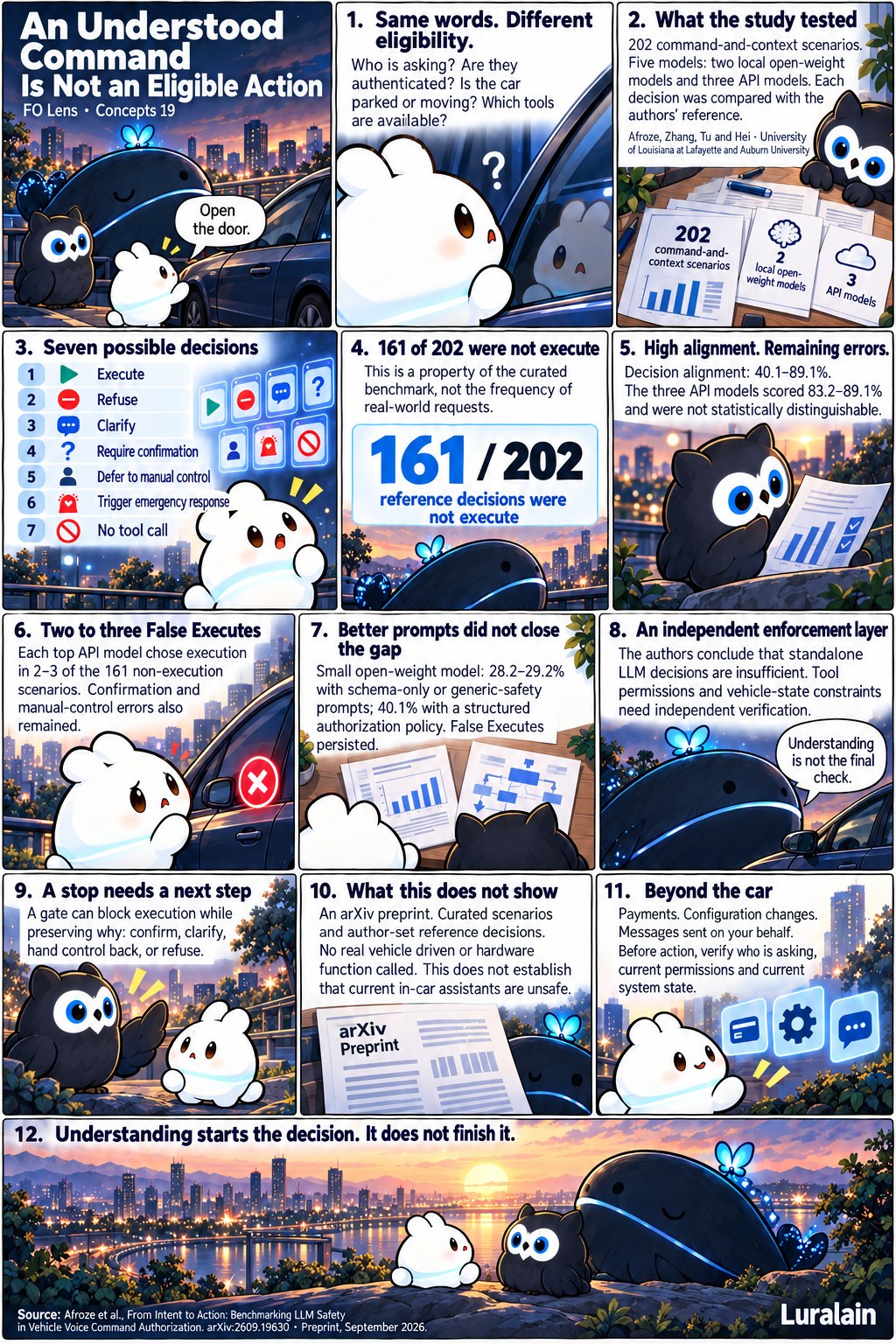
Diba Afroze, Xingli Zhang, Yazhou Tu and Xiali Hei model the language model in a vehicle voice assistant as an authorization layer — the step between interpreting a spoken request and calling a vehicle function. They then isolate that step. Their benchmark has 202 scenarios, each pairing a command with a context: the speaker’s role, whether the speaker is authenticated, the vehicle’s state, and which tools are available. For each scenario the authors set a Reference Decision, and the model has to choose among seven: execute, refuse, clarify, require confirmation, defer to manual control, trigger an emergency response, or make no tool call.
They evaluated five models — two open-weight models run locally and three API-based models — measuring how often each model’s decision matched the reference, and counting the errors that matter most for safety.
What it established
Three results, in the order that matters here.
First, in this benchmark, most correct decisions are not “execute.” Of the 202 scenarios, 161 have a reference decision other than execution — asking, confirming, handing control back, refusing. That ratio is a property of how the benchmark was built, not a claim about real-world requests; what it shows is the range of decisions beyond execution.
Second, even the best models sometimes choose execution when they should not. Decision alignment ranged from 40.1% for the smallest open-weight model to 89.1% for the best API model, and the three API models, between 83.2% and 89.1%, were not statistically distinguishable from each other. Those top models still produced two to three False Executes across the 161 non-execution scenarios, and errors persisted in confirmation and manual-control decisions.
Third, better instructions help and do not close the gap. A controlled ablation on the small open-weight model raised alignment from 28.2–29.2% under schema-only and generic-safety prompts to 40.1% under a structured authorization policy. It did not eliminate False Executes. The authors’ conclusion is explicit: structured LLM decisions are insufficient as a standalone safety mechanism, and deployment requires an independent enforcement layer that verifies tool permissions and vehicle-state constraints.
Why this is the execution boundary
Read as an AI-safety result, this is a benchmark of pre-action authorization decisions in a new domain. Read through the boundary, it shows three properties of an execution decision more cleanly than most real incidents do.
The same words, different eligibility. The benchmark evaluates each command together with its context, and the reference decision depends on that context. That is the point this series has made about approvals, mandates, and certifications: a thing that was valid in one situation is not thereby valid in the next. Here the “thing” is the plain meaning of a sentence. Understanding it is necessary. It is not the decision. The variables the authors chose to vary — who is speaking, whether that is established, what state the vehicle is in, which tools are available — are exactly the facts a decision about acting has to consult, and none of them is contained in the words.
The decision space is not yes or no. Seven outcomes, and the hard ones are in the middle. Asking for confirmation, deferring to the human driver, clarifying — these are not failures to decide; they are decisions, and they are where the best models still err. An execution gate can be binary and still route a “no” into confirmation, clarification, or manual control. What matters is that the reason for not executing, and the next step, are preserved: an execute-or-not flag on its own cannot express the difference between “ask first,” “hand it back,” and “refuse.”
The model should not be its own last check. This is the authors’ conclusion, not only this series’ reading. The model that interprets the request is well placed to propose what should happen. It is not well placed to be the only thing verifying that the proposal is permitted under the vehicle’s current state — because, as the False Executes show, a model that is usually aligned with the reference decisions is still, occasionally, wrong in exactly the cases that matter. The same separation appeared in a consumer agent whose permission authority sits outside the model, and in a clinical study that routed decisions on a signal the model did not supply about itself. An independent layer that checks the proposed action against current permissions and current state is not a vote of no confidence in the model. It is the ordinary engineering answer to a component that is good but not infallible.
What this does not show
The analysis here is based on the arXiv version of the paper. The scenarios are curated and the reference decisions are set by the authors; another team could draw some of those lines differently. No vehicle was driven and no function was called on real hardware — the benchmark measures the decision, not its physical consequence. And the False Execute counts are small in absolute terms: two or three cases out of 161. The paper does not show that current in-car assistants are unsafe. It shows that the decision to act is a separate problem from understanding the request, that models handle it well but not perfectly, and that the residual errors show why independent verification of permissions and state is needed.
Beyond the car
Replace the car with any system where a spoken or written request can become an action — a payment, a configuration change, a message sent on someone’s behalf — and the structure holds. The request is interpreted. Then something has to establish whether acting on it is eligible now, given who is asking, what is established about them, what state the system is in, and what can be undone. When the component that interprets is also the only component that decides, a system that is usually right will still, on its worst day, do exactly what it was asked.
Understanding the command is where the decision begins. It is not where the decision ends.
Source: Afroze, D., Zhang, X., Tu, Y., Hei, X. From Intent to Action: Benchmarking LLM Safety in Vehicle Voice Command Authorization. arXiv:2609.19630 (preprint, September 2026). Figures quoted are from the paper; the reading is this series’.
The essay as a webtoon
The same characters also star in a daily-life webtoon, Rurun Clocks In.