The Agent That Was Approved Is Not Always the Agent That Acts
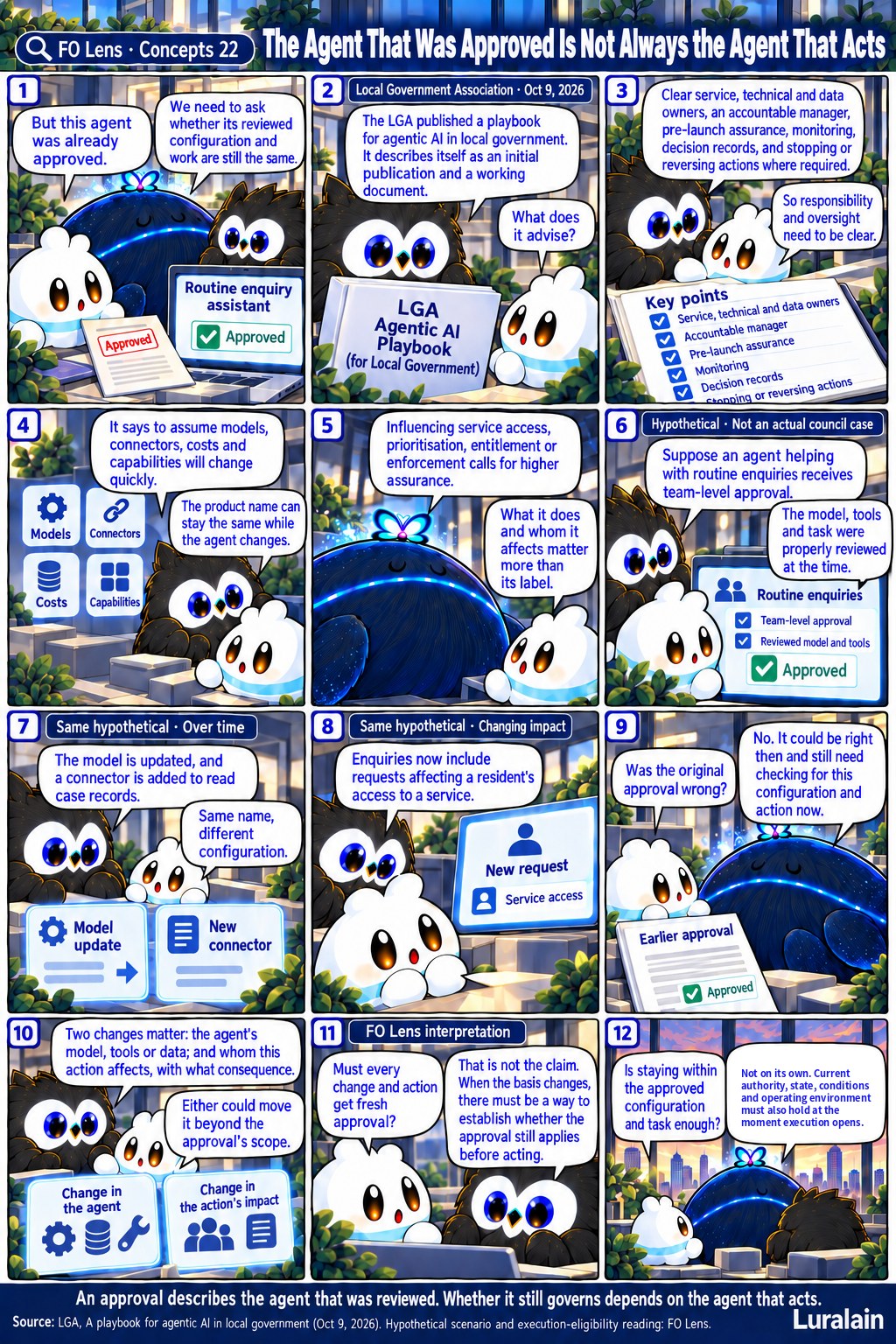
A playbook for English councils tells them to assume their AI agents will change: models, connectors, costs and capabilities. If what was reviewed can change after approval, the approval has to be read as a statement about a particular configuration, and its basis has to hold when the agent acts.
The claim
An approval to deploy an AI agent is made about something specific: a model, a set of connected tools and data, a defined task, an expected impact. Agents are not fixed objects. When the thing that was reviewed changes, the approval does not change with it. It continues to describe the agent as it was.
The question is then not only whether an agent was approved, but whether the basis of that approval still holds when the agent acts.
What the playbook says
On October 9, 2026, the Local Government Association published A playbook for agentic AI in local government, led by North Yorkshire Council’s head of AI strategy and innovation, with contributions from several English councils. It describes itself as an initial publication and a working document, setting out advised principles for adoption.
The playbook defines agentic AI as a system that can work towards a defined goal, use approved knowledge sources or tools, and carry out tasks within boundaries set by people. It calls for clear service, technical and data owners, an accountable human manager for each agent, monitoring with assurance sign-off before going live, trails recording decisions and outputs, and the ability to stop or reverse an action where required.
Two passages are central to this reading.
The first concerns change. Under the heading “Not all agentic tools are the same,” the playbook advises councils to “assume agents will vary over time: models, connectors, costs and capabilities change quickly,” and concludes that governance needs to focus on principles, controls and monitoring rather than a single product label.
The second concerns impact. The playbook states that risk should increase where an agent influences, recommends or automates decisions affecting residents, businesses, staff, service access, prioritisation, enforcement or entitlement. Its appendix sets out a proportionate rollout model, drawn from North East Derbyshire District Council, in which governance scales from personal use, to team or service use, to organisational use with formal corporate approval. It adds that an agent influencing triage, eligibility, enforcement, prioritisation or resident-facing advice should move to a higher assurance category, even within a single service. Separately, under its accountability-first principle, the playbook gives an example: an owner may decide not to deploy agents in safeguarding decision-making while approving them for lower-risk tasks such as managing green bin subscriptions.
What is established
The playbook establishes, as advice to councils, that agents should be governed by what they do and what they affect, not by what product they are. It establishes that the components of an agent are expected to change. And it establishes that the level of approval should follow the level of impact.
Read together, those three points carry a consequence the playbook’s own framing makes visible. An approval is granted at a particular tier, for a particular configuration, on the basis of a particular expected impact. Each of those can move after the approval is given.
Reading this at the execution boundary
Consider an agent approved at the team level to help a service handle routine enquiries. The approval was sound. It reflected the model the agent used, the tools it was connected to, and the kind of task it performed.
Over the following months, the underlying model is updated by its provider. A new connector is added so the agent can read case records. The enquiries it handles begin to include requests that bear on someone’s access to a service. None of these steps is unusual, and each may be reasonable on its own. But the agent now acting is not the agent that was reviewed, and some of what it does now falls into the category the playbook says deserves higher assurance.
Nothing about the original approval has become false. It was an accurate decision about the agent as it was. The question is whether that decision still applies to this agent, doing this task, when this action opens. A decision can be right when it is made and no longer apply when execution opens.
Two different kinds of change are involved, and they are worth keeping apart. One is change in the agent: its model, connectors, data or capabilities. The other is change in the action: what a particular request affects, for whom, and with what consequence. The first moves the basis of the approval. The second may move the action beyond the scope or assurance tier the approval was given for. Either can mean that the approval, while still on record, no longer covers what is about to happen.
What this does not claim
This reading does not claim that the playbook is incomplete or that councils following it are exposed. The playbook is explicit that governance should rest on principles, controls and monitoring, and it provides for monitoring, records of decisions and outputs, and the ability to stop an action. FO Lens reviewed the published web version of the playbook. The page reviewed does not set out a specific procedure for re-approval when an agent’s components change, and this piece does not assume what councils do in practice.
It also does not claim that every change requires a new approval, or that every action must be re-reviewed. The point is narrower: when the basis of an approval moves, there needs to be a way to know whether the approval still applies before the agent acts on it.
Generalizing
Any approval of an automated actor is an approval of a configuration at a moment. Models are updated, tools are added, data sources are connected, and the work an agent is given drifts toward new kinds of request. Product labels stay the same through all of it. Records of approval stay the same too.
The useful question is therefore not “was this agent approved?” but “is the agent that is about to act still the one that was approved, for an action of the kind it was approved for?” Earlier reviews still matter, but that question has to be answered again at the moment execution opens, because an earlier review cannot by itself establish that the agent and the action are still within what was approved.
Even where they are, the approval is not the whole answer. Execution eligibility also depends on whether the authority, state, conditions and operating environment that the action relies on still hold when execution opens.
An approval describes the agent that was reviewed. Whether it still governs depends on the agent that acts.
Source note. This piece draws on the Local Government Association, A playbook for agentic AI in local government (October 9, 2026), including its section “Not all agentic tools are the same,” its advised principles for adoption (including the accountability-first principle), and Appendix 1, the proportionate rollout model attributed to North East Derbyshire District Council. The scenario in “Reading this at the execution boundary” is hypothetical. FO Lens has not reviewed any council’s implementation of the playbook. The execution-eligibility reading is FO Lens’s.
The essay as a webtoon
The same characters also star in a daily-life webtoon, Rurun Clocks In.