A Recognized Agent Is Not a Current Approval
Visa, BILL and Billtrust are running a live pilot in which an AI agent completes approved invoice payments inside supplier portals. The agent is recognized when it reaches the supplier. What that recognition establishes, and what it leaves to another boundary, is the distinction worth naming.
The claim
When an approved action is completed by an agent inside another organization’s system, the receiving side meets an actor, not an approval. It can establish who the actor is and whom it acts for. That establishes recognition. It does not, by itself, establish that the approval the actor carries still holds: still in force, and still describing what is about to be paid.
Recognition is a property of the actor at the door. Whether the approval still holds as the action completes is a property of the action at the moment it executes.
What the pilot does
On October 20, 2026, Visa, BILL and Billtrust announced what they describe as the first live pilot in which trusted AI agents initiate and complete approved buyer invoice payments end to end through supplier portals. According to the announcement, the pilot is live and processing transactions between participating buyers on BILL and suppliers on Billtrust.
The problem it addresses is specific. Supplier payment portals have typically relied on human authentication, which left the last step of an already-approved payment to someone entering it by hand.
The announcement describes the flow this way. A payment agent operated by BILL, registered through Visa’s Trusted Agent Protocol and Agentic Directory, issues payments for BILL’s customers using tokenized card credentials and controls aligned with the buyer’s approved payment instructions. On the supplier side, Billtrust uses the same protocol to recognize and authenticate the agent and grant it access to the portal. That authentication can stand in for protections such as CAPTCHA without a separate agent login. Suppliers receive the payment in accordance with their own acceptance policy.
The companies list what the pilot is meant to provide: an authenticated agent acting for an identified buyer; tokenized credentials in place of shared portal logins; payment controls tied to the approved instruction; a payment path tied to the specific invoice; and visibility into authorization and completion. A Billtrust executive frames the design as a link between invoice approval on the buyer’s side and payment acceptance on the supplier’s side.
The announcement’s FAQ addresses the obvious concern directly. Asked whether the AI agent makes payment decisions, it answers no: the agent executes only “eligible payments that have already been approved by the buyer.” It describes Visa’s role as enabling agent recognition, tokenized payment credentials and payment controls, and notes that B2B payments already operate within established approvals, controls and the buyer’s rules.
What is established
The announcement establishes that, in this pilot, the agent does not carry a general authority to pay. It carries one buyer’s approved instruction for one invoice, and it is recognized as a specific agent acting for a specific buyer when it arrives.
It places payment approval outside the agent’s decision-making role. It describes the agent as executing eligible payments that the buyer has already approved, without specifying when or how that eligibility is confirmed.
By its own description, it also establishes that each transaction passes through two decisions held by two parties. The buyer’s approval is made in the buyer’s system. The supplier’s acceptance is applied in the supplier’s portal, under the supplier’s policy. The agent is what connects them.
Reading this at the execution boundary
Look at the moment the agent reaches the supplier’s portal. What the portal can establish there is substantial: this is a registered agent, acting for an identified buyer, presenting tokenized credentials tied to an approved instruction for a specific invoice. Each of those is a fact about the actor and what it presents.
The FAQ’s wording sharpens the question rather than settling it. Read naturally, eligibility in that answer is a property the payment has when the agent takes it up: approved, and within the buyer’s rules. The announcement does not say when that eligibility is established, or whether the conditions that made the payment eligible are confirmed again as it completes. That is not an omission to fault in a press release. It is the point at which this series’ question begins: not whether the payment was eligible, but whether what made it eligible still holds at the moment it is paid.
Now consider what that depends on, and where each part lives. On the announcement’s description, whether the buyer’s approval is still in force is held on the buyer’s side. Whether the invoice being paid is still the invoice that was approved, with the same amount and the same remittance details, is at least partly held on the supplier’s side, which issued it. The payment flow operates on the buyer’s approved instruction, but the announcement does not specify how the current validity of that instruction is represented or verified across the two systems. Neither side, from its own records alone, necessarily sees the other’s half.
An earlier essay in this series examined how a consent ages across a wait. The point here is different, and it holds even when the wait is short. In a flow that crosses organizations, whether the approval still holds is a joined fact. Recognition at the door is not where it is joined, because recognition answers a question about the actor, and whether the approval still holds is a question about state that sits on both sides of the door.
The pilot’s described controls address part of this directly: the payment path is bound to a specific invoice, and the controls are bound to the approved instruction. That is the right shape. What a public announcement cannot show is where the two halves are checked against each other when one of them moves (a revised invoice, an updated remittance detail, an approval withdrawn after a dispute surfaces), at what moment, and in whose record that check appears.
A protocol can make recognition very strong without, on its own, settling whether the approval still holds. The stronger recognition becomes, the easier it is to let it stand in for the other question.
What this does not claim
This reading does not claim that the pilot lacks such checks, or that payments made through it are exposed. The announcement describes invoice-bound payment paths, instruction-bound controls, visibility into authorization and completion, and an agent that executes only eligible, buyer-approved payments. The pilot may well handle the situations described above. FO Lens reviewed the public announcement, including its FAQ. No implementation detail beyond it is assumed.
It also does not claim that agent authentication is the wrong layer to strengthen. Replacing shared portal logins with authenticated agents and tokenized credentials removes a real weakness. The point is narrower: recognizing the actor and confirming that its approval still holds answer different questions, and a flow that crosses organizations has to answer both.
Generalizing
This series has read the same edge from other sides. A signed mandate can prove that an execution is covered by delegated authority without proving it may proceed now (Cases 28). A consent given before a wait does not, on its own, stay current through the wait (Cases 31). The state that governs an execution is often not held in one system (Concepts 16).
Agent recognition adds a version specific to flows that cross organizations. Approved actions increasingly complete somewhere other than where they were approved: an invoice approved in an accounts-payable system is paid in a supplier’s portal; an instruction approved by one team is carried out by a service another team runs. In each case, the receiving boundary can be certain who has arrived and still not know whether the approval they carry describes what is about to happen.
The useful question at that boundary is therefore not only “is this a recognized agent?” but “does what made this action eligible still hold, here, as it completes?” Answering it may require state the receiving side does not hold. That is not a reason to stop at recognition. It is a reason to decide, before the flow runs, where the two halves of the answer are brought together.
And an approval that still holds is not the whole of it. The action also depends on whether the authority, state, conditions and operating environment it relies on still hold when execution opens.
Recognition tells the door who has arrived. It does not tell the door whether the reason they came still holds.
Source note. This piece draws on Visa, BILL and Billtrust, Visa, BILL and Billtrust Launch First Live Pilot for Trusted AI Agent Payments Between Buyer and Supplier Platforms (October 20, 2026), including its description of the payment flow, its list of pilot capabilities, and its FAQ. The account of the pilot is taken from this announcement; it is not the result of independent verification of the implementation. The execution-eligibility reading is FO Lens’s.
The essay as a webtoon
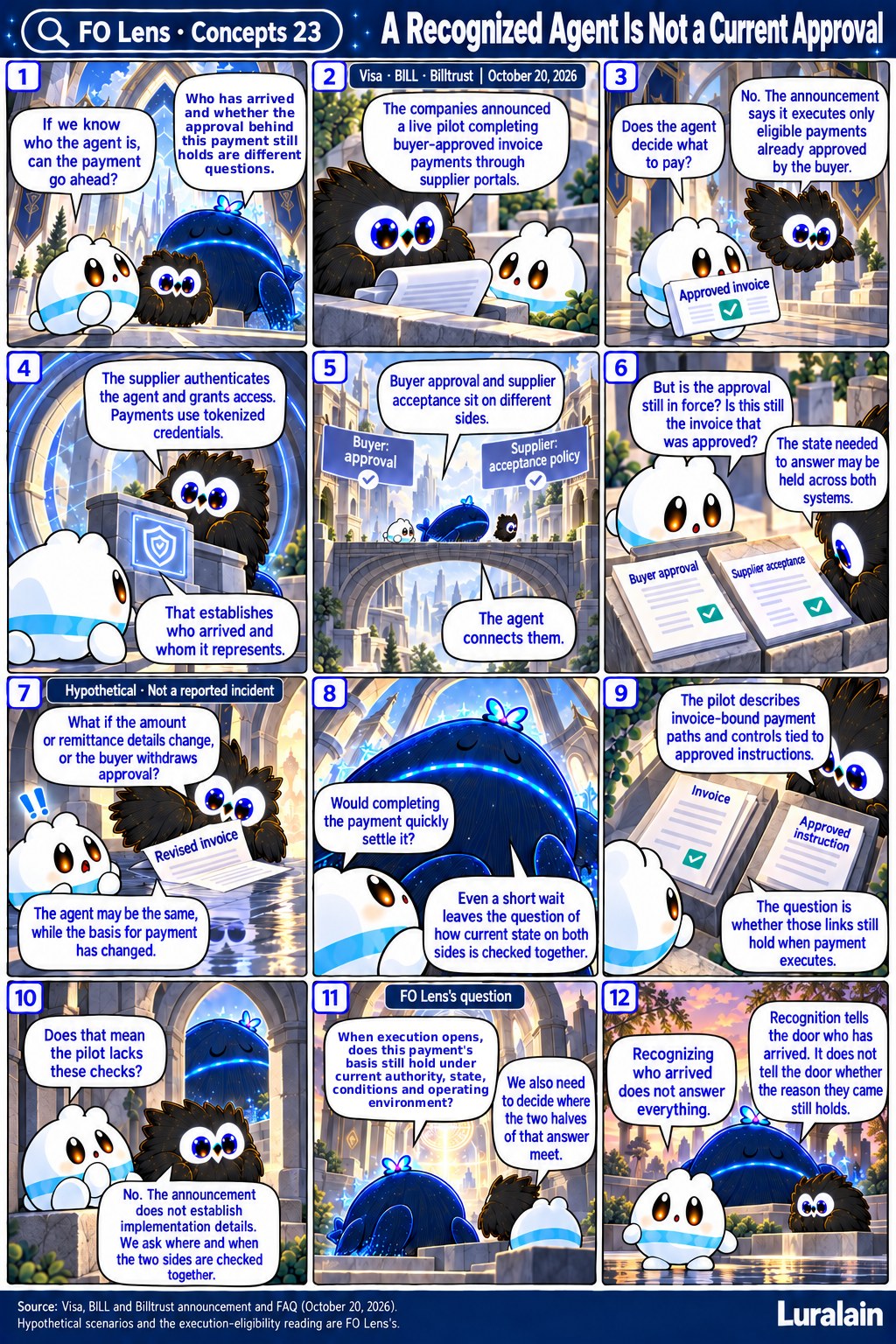
The same characters also star in a daily-life webtoon, Rurun Clocks In.