A Liability Rule Is Not an Execution Check
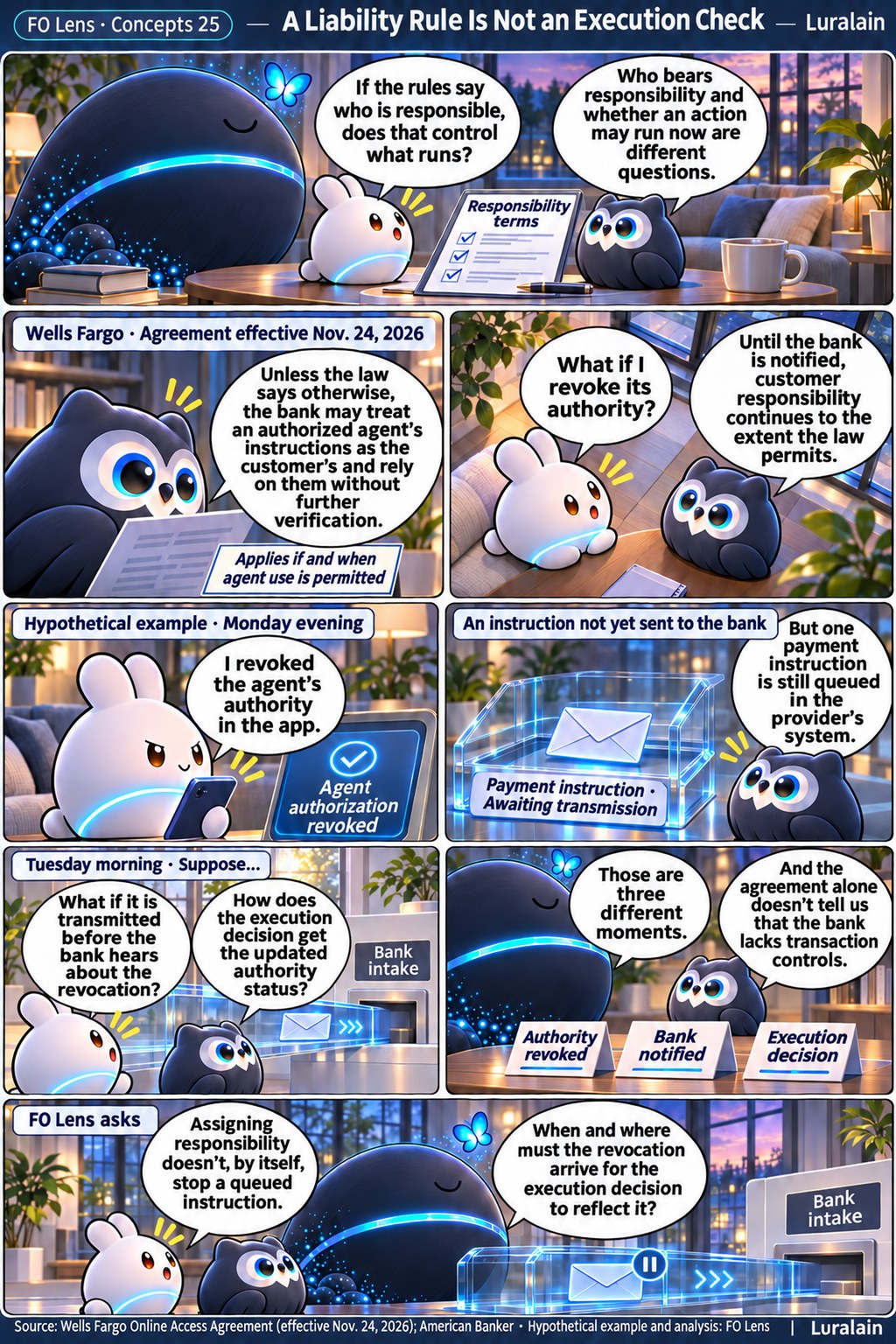
From 24 November 2026, Wells Fargo's online access agreement treats instructions from an AI agent a customer authorizes as the customer's own and, unless the law provides otherwise, lets the bank rely on them without further verification. The customer remains responsible, to the extent the law permits, until the bank is notified that the authorization has been revoked. The agreement sets terms for responsibility and notice. When a customer withdraws an agent's authority, what makes that withdrawal effective for an instruction already in flight?
From 24 November 2026, Wells Fargo’s online access agreement will contain a section on third-party AI agents. If a customer authorizes an agent to use online banking, the bank treats the agent’s instructions as the customer’s own and, unless the law provides otherwise, may act on them without further verification. To the extent the law permits, the customer remains responsible for what the agent does until the bank is notified that the authorization has been revoked. This piece reads one distinction the section makes visible. The agreement sets terms for responsibility, revocation of an agent’s authorization and notice to the bank. How is the withdrawal reflected when a pending instruction reaches the point at which execution is permitted?
Responsibility and eligibility are settled by different rules
A liability rule says who bears the consequences of an action. An execution check asks whether the action should take place now.
The first can be written once, in advance, for every action of a kind. The second has to be answered for each action, when it is about to run.
What Section 15 says
The upcoming agreement lists among the topics it covers “your responsibilities for artificial intelligence agents, if and when we permit the use of such agents.” Section 15, “Third-Party Artificial Intelligence Agents or Agentic AI,” defines an AI agent broadly: any software, application, program or other technology that acts on a person’s behalf, whether autonomously, semi-autonomously or not.
The section then sets out the arrangement in a few steps.
- The relationship. The customer’s use of an agent is governed by the agent provider’s terms. “We do not provide, control, or endorse any AI Agent,” the agreement says, and the bank does not monitor or certify agents’ security or privacy practices (15(b)).
- Reliance. Unless otherwise provided by law or regulation, instructions from an agent the customer authorizes are treated as the customer’s. The bank may rely on them as binding and has no duty to verify the agent’s authority (15(d)).
- Responsibility. Use is at the customer’s own risk. The customer is responsible for monitoring the agent, for the accuracy of its instructions and for its errors or unauthorized actions. The bank does not monitor agent activity (15(e)).
- Revocation. The customer must revoke an agent’s authorization properly and in time, take any further action needed to stop the agent’s activities, and keep evidence of the revocation to provide on request. Until the customer notifies the bank under the notice provisions of Section 17(d), the customer remains responsible for the agent’s activities “to the extent permitted by law or regulation” (15(f)).
- The bank’s own levers. The bank may change security requirements, including requiring agents to be registered, and may limit or terminate any agent’s access (15(g)).
Section 2(b) addresses transactions by Authorized Representatives and Delegates, including their AI Agents. Subject to applicable law or regulation, those transactions are considered authorized unless the customer has notified the bank that the representative or delegate is no longer authorized and the bank has had a reasonable opportunity to act on that notice. Section 20(c) also extends the indemnity to claims arising from use of the service by their AI Agents.
American Banker reported that a Wells Fargo spokesperson said customers can grant or revoke an agent’s access outside the bank, and that the bank may not have visibility into when that happens. The same report noted that JPMorgan Chase has also changed its online banking terms to make customers liable for actions taken by agents they authorized.
What the agreement establishes
It establishes an allocation. For actions taken through an authorized agent, the customer is the party who answers, and, unless the law provides otherwise, the bank is entitled to rely on the instruction as given.
It establishes where the customer’s own controls are expected to sit: in monitoring the agent, in revoking it, in stopping its activities and in telling the bank.
It makes notice to the bank relevant to the customer’s continuing responsibility, subject to applicable law. The operational question is how that notice changes the treatment of instructions already in flight.
Where withdrawn authority meets a pending instruction
Consider a hypothetical household using an agent to pay recurring bills. On Monday evening, the customer revokes the agent’s authority in the provider’s app. At that point, a supplier-payment instruction remains queued in the agent provider’s system and has yet to be submitted to the bank. Suppose it is nevertheless transmitted on Tuesday morning, before the bank receives notice of the revocation. What makes the withdrawn authority visible when the bank decides how to handle that instruction?
Three moments have separated: when the authority was withdrawn, when the bank is told, and when the pending instruction is acted on. The agreement speaks to the second, by making notice relevant to responsibility. It asks the customer to manage the first, by revoking the agent and taking any further action needed to stop it. The third is where the instruction either executes or does not.
The section is candid about where that matters. The bank does not monitor agents and, unless the law provides otherwise, does not undertake to verify an agent’s authority. The spokesperson’s point about visibility names the gap directly: the moment a customer withdraws authority and the moment the bank can know it are different moments. During that gap, an instruction can still fall under the customer’s responsibility under the terms while no longer reflecting the authority the customer has given.
The risk is in how such terms can be read. A clear allocation of responsibility can start to look like a control, as if knowing who will answer for an action made the action safer to execute. Allocation does not by itself change whether a particular instruction runs. It settles who absorbs the cost if it runs when it should not have.
What this reading does not claim
This reading does not claim that Wells Fargo lacks fraud controls, transaction limits or other checks on payments. Section 15(d) describes the bank’s contractual position on reliance. It is not evidence about which checks the bank performs on transactions in operation, and the agreement reserves the right to require registration and to limit or terminate agent access.
It does not claim that contracts cannot set conditions on execution. Agreements can and do define revocation procedures and the conditions under which instructions are honoured. The question here is how those terms reach a particular pending instruction.
It does not claim that the allocation is unfair or unlawful. That is a legal question FO Lens does not assess, and the agreement itself limits the customer’s responsibility to what the law permits.
It does not claim that Wells Fargo currently permits AI agents to use its online service. The agreement frames these responsibilities as applying “if and when” it does.
Withdrawal has to reach the point of execution
This series has read neighbouring versions of the same edge. Recognizing an agent at a boundary establishes who has arrived, not whether the approval it carries still holds (Concepts 23). A signed mandate can prove that an action is covered by delegated authority without proving that everything it relies on still holds now (Cases 28).
Revocation adds a timing problem to both. Authority can be withdrawn in one place, recorded in another and relied on in a third. Terms of service for automation tools, delegation clauses in procurement and indemnities in platform agreements all face the same arrangement. Each is written in advance. Each still has to be applied to a particular action at the moment it runs, using whatever state of authority has reached that moment.
The proposition
The agreement sets terms for responsibility and notice. Applying those terms to a pending instruction requires the relevant authority state to reach the execution decision.
When authority is withdrawn, what makes that withdrawal effective for an instruction already in flight?
Source note. This piece draws on the Wells Fargo Online Access Agreement, version effective 24 November 2026, in particular Sections 2(b), 15, 17(d) and 20(c). The spokesperson’s comment and the JPMorgan Chase comparison are as reported by American Banker (Penny Crosman, 2 November 2026; also republished by National Mortgage News). This piece is not legal advice and does not describe how Wells Fargo applies the agreement in practice. The bill-payment example and the execution-eligibility reading are FO Lens’s.
Related
- A Recognized Agent Is Not a Current Approval — Concepts 23: what recognizing an agent at the receiving boundary establishes, and what it leaves open.
- A Valid Mandate Is Not Current Execution Eligibility — Cases 28: why a signed mandate and current eligibility are checked against different objects.
- Approval Is Not Execution Eligibility — Concepts 11: why an approved action can stop being the action that was approved.
The essay as a webtoon
The same characters also star in a daily-life webtoon, Rurun Clocks In.